Climate protection and development in the Global South
Developing countries can achieve modest prosperity while reducing emissions substantially in three ways: Shift to low carbon energy sources, increase energy efficiency overall, and use materials and services more efficiently.
An Indian laborer works on an under construction flyover in Jammu, India, Monday, Feb.1, 2021. Material efficiency is crucial in reducing emissions in developing countries. (Photo: AP Photo/Channi Anand/NTB)
Kommentar
Dette er en kommentar. Den gir uttrykk for skribentens egne meninger.
Nobody is as affected by the damaging forces of climate change as underdeveloped countries, but these countries face a paradox as they try to mitigate their CO2 emissions. Improving the lives of their citizens will increase the demand for energy and materials — which in turn will make climate change worse.
It may seem like an insolvable problem. But the combination of clean energy, efficient energy use, and material efficiency can allow the Global South to develop while reducing greenhouse gas emissions, our research shows.
A Northern ploy?
Developing countries are gravely exposed to the harms that result from global warming — increased frequency and severity of heat waves, droughts, storms, and floods, as well as sea level rise. While temperatures are increasing more in polar and temperate regions than in the south, it is in the tropics that wet-bulb temperatures threaten to surpass a lethal level.
It is very much in the interest of poor countries in the Global South to mitigate greenhouse gas emissions. Yet, some politicians and businesspeople see climate change mitigation as a Northern ploy to cheat them out of the opportunity for development. The North developed its infrastructure, buildings, and factories without consideration for the climate. Why should people in the South be denied this opportunity?
Well, they don’t need to.
Those Southern politicians correctly point out that it is our obligation in the North to take a lead in mitigating greenhouse gas emissions. People in the North have filled up more than their share of the planet’s atmosphere with CO2. Yet today, the 6.5 billion inhabitants of low and middle-income countries emit more greenhouse gases (62% of global CO2) than 1.2 billion inhabitants of high-income countries, an improvement over historically even more inequitable emissions. China’s per-capita emissions have even surpassed those of Europe. Continued industrialization following a Northern or Chinese model threatens indeed to accelerate climate change.
Prosperity and emissions reductions
A different development pathway is possible. The South can achieve modest prosperity while reducing its emissions substantially in three ways: They can shift to low carbon energy sources, increase energy efficiency overall, and use materials and services more efficiently, too.
Here’s how — and why — these approaches can work.
Today, photovoltaic cells produce the cheapest electricity in India, undercutting dirty coal. In East Africa’s Rift Valley, wind power plants can deliver full-load electricity in 60% of the time, which is more reliable than many of the continent’s electricity grids. So there’s no doubt that clean energy offers hope for developing countries.
But can clean electricity production be ramped up quickly enough to replace dirty power plants, as well as to provide for rapid growth? Land-use conflicts arise. The electricity grid needs to be strengthened and expanded. There are high up-front costs. That’s why increasing energy efficiency is also critical.
Energy efficiency has long been in focus when it comes to reducing energy needs. In powering machines, electric motors are more efficient than combustion engines. LEDs offer the same light as incandescent or oil lamps for a small fraction of the energy. Well-designed buildings require much less or no mechanical cooling. Those savings should help shrink the gap between new supplies of clean energy and overall demand.
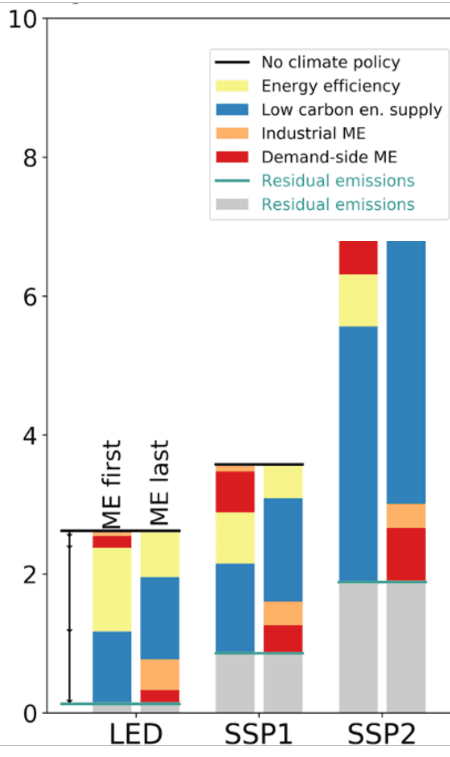
Fig. 1: Contribution of different emission reduction strategies to the reduction of GHG emissions from residential buildings and passenger vehicles in 2050 for the Global South. (Annual GHG emissions, 2050, GtCO2e.) Source: Nature Communications
Concrete in new buildings, steel in new machines, factories, and vehicles, copper in new wires. There are many opportunities to reduce material use, and most of them can be found in emerging economies.
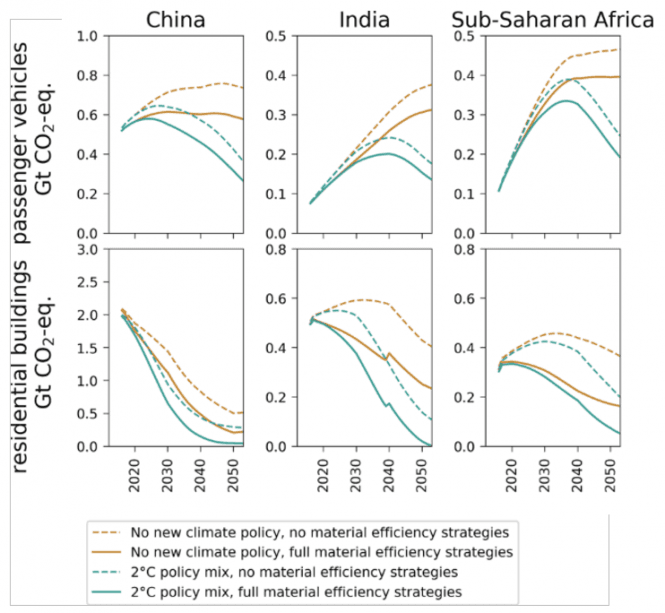
In China today, the average lifetime of a building is 23 years. Designing and building buildings that last longer can reduce the use of concrete, steel, and glass. Individually owned cars are parked 22 or more hours a day. Shared fleets of vehicles offer mobility with fewer vehicles. Clever designs of buildings can save substantial amounts of structural steel. According to our modeling, such strategies can deliver up to a quarter of the potential emissions reductions from the passenger vehicle and housing sectors in the Global South.
Fig. 2: Annual GHG emissions from the making, use, and disposal of cars and homes in selected developing and emerging countries depending on whether material efficiency is implemented, and the energy system is decarbonized. Source: Nature Communications
Energy and material efficiency offer avenues to reduce the total energy demand. Often, these kinds of efficiency strategies are readily available, require fewer capital outlays, and generate less conflict than renewable electricity or nuclear power. By reducing process-related emissions in material production, material efficiency offers emissions reductions that can’t be supplied through renewable energy alone. Our modeling clearly shows: if developing countries implement all three of these strategies, climate change mitigation doesn’t need to hamper the kind of development the Global South needs to bring a better quality of life to its citizens.