Renewables losing market share in Africa

Wind is growing in Africa, but not fast enough to keep up with fossil fuel growth. Photo from Tarfaya wind power project in Morocco.
Dette er et debattinnlegg. Teksten er kvalitetssikret i tråd med redaksjonelle prinsipper for publisering. Innholdet reflekterer skribentens egne meninger.
Despite all the talk of making Africa greener, the share of renewables in Africa's power production actually dropped in the period from September 2017 to September 2018. These alarming data was presented at the launch of the 2018 "African Energy Data Book", at the occasion of the Africa Investment Exchange in London November 15.
According to the same publication, the proportion of renewable energy in the generation mix has declined so far in 2018 in all regions except Central Africa. Despite a slight increase in the overall share of wind and solar in three of the five regions, the slow growth in hydro combined with sustained growth in all forms of hydrocarbons resulted in an overall increase in the share of plants running on hydrocarbons and a corresponding reduction in the shares of renewables.
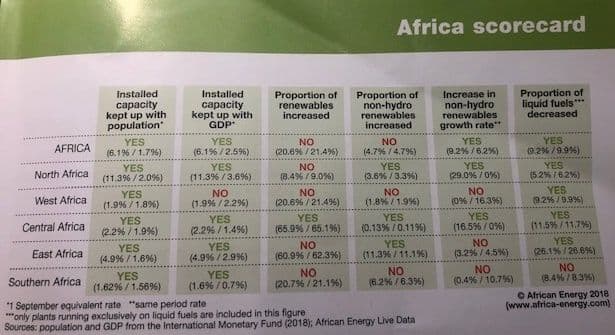
The use of both the two most polluting sources of power production, coal and liquid fuels, are still growing in Africa. Since 2010, coal power has increased its installed capacity in Africa by 13%, and is expected to peak in 2022 at 60 GW. Perhaps more surprising is the increased reliance on liquid fuels – diesel, HFO (High Sulphur Oil) and other fuels – in the power sector. Overall, the share of plants running exclusively on liquid fuels rose from 8,6% to 19% in 2018. In addition, a large share of the dual gas/liquids-powered plants built in Africa are running on liquids as well.
In reality, the dominance of fossil fuels in Africa's electricity generation is higher than accounted for here. This is because the African Energy Live Data does not include the so-called "Emergency power" segment, i.e the millions of distributed diesel gensets (generators) feeding directly into large and small energy users across Africa. Emergency power from diesel generators typically counts for 10–20 percent the total generating capacity in Sub-Saharan Africa, according to a recent study cited in my blog - «Energy access for all» – a double-edged sword?. In Nigeria alone, it is estimated that the county’s 9 million generators emit 19 million tons CO₂ per year, equal to the emissions from 4–5 average-sized coal power plants.
The growing dependence on fossil fuels in power generation, highlights the urgent need to accelerate investments in renewables across the continent. But experience shows that the conventional strategy of mainly relying on centralized power plants combined with high-voltage transmission to the population and economic centers take far too many years to implement and often become more expensive than originally anticipated. Distributed renewable generation – i.e generation closer to the user and often behind the user's meter – can bring affordable power to Africa's users quicker and to a lower cost than the alternatives.

