0.5°C makes a big difference for mitigation
Keeping global warming below 2°C is hard, but 2.5°C is a walk in the park!
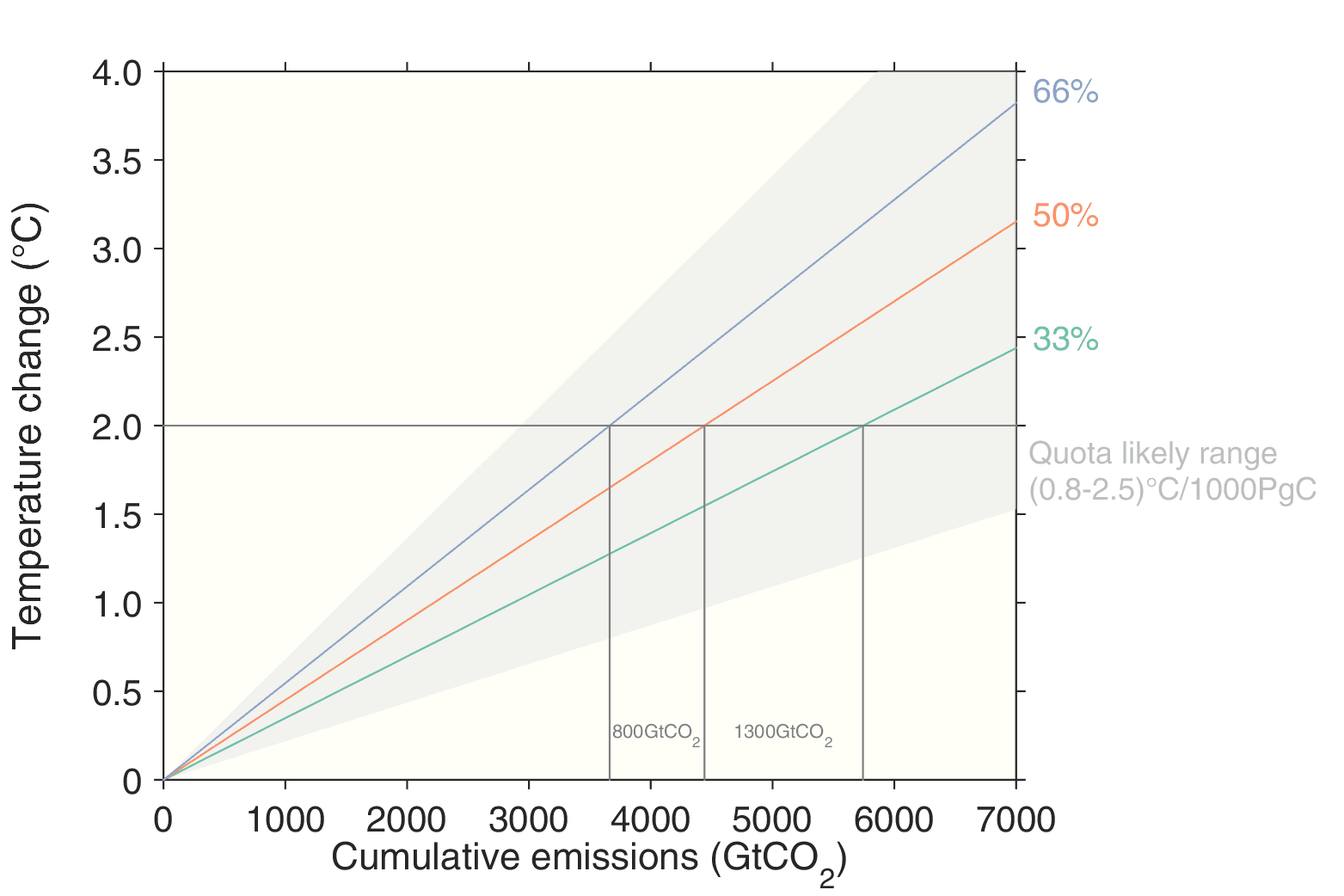
The total quota for a 2°C threshold increases by 800GtCO2 for a decrease in the likelihood from 66% to 50%, assuming the non-CO2 temperature contribution remains constant.
I have had a few blog posts on the carbon budget concept, uncertainties, and fossil fuels.
One could say I have struck a somewhat negative tone, perhaps in line with my reputation?
When I feel like I’m not depressed enough about climate change, I like to check out Glen’s tweets https://t.co/o2p2FHYIKp
— RottnestWindTurbine (@Rottoturbine) April 21, 2017
Despite complexities, the carbon budget does have many useful qualities. For one, it means that net zero emissions are necessary to stay below any temperature level. Another, it makes it easy to illustrate the magnitude of the mitigation challenge. And yet another, it makes it easy to translate between temperature levels and probabilities, such as defining «well below 2°C«.
It is this last point I want to build on in this blog post.
Last year I published a commentary «The ‘best available science’ to inform 1.5°C policy choices», highlighting some of my views on the IPCC Special Report on 1.5°C. My recent blog posts, coincidently, are often on issues I raised in the commentary. Issues that still weigh on my mind!
As with many articles, the best parts are in the Supporting Information, which is coincidently free.
One thing I discussed in the commentary is how much the budget changes given a change in the temperature level or probability of staying below a given target.
The carbon budget and temperature levels
The total cumulative carbon budget increases by 900GtCO2 if the temperature threshold increases 0.5°C with a 66% probability, assuming the non-CO2 temperature contribution remains constant.
This is a direct consequence of the linear relationship between temperature and cumulative emissions.
The strength of the relationship changes depending on the probability. At a 50% probability, every 0.5°C change increases the carbon budget by 1,100GtCO2. At a 66% probability, every 0.5°C change increases the carbon budget by 900GtCO2.
This is an important finding. If 2°C becomes infeasible, as I have previously argued, then it turns out that 2.5°C is much easier, basically doubling the remaining carbon budget!
The emission pledges to the Paris Agreement are woefully inadequate, but they could easily take us to 2.7°C-3°C without many changes in current effort. This is really a consequence of the big change in carbon budget for an increase in the temperature level (from 2°C to 2.7°C-3°C).
This means that even if 2°C is not feasible, 2.5°C could be rather achievable! 0.5°C makes a big difference for mitigation.
To be clear, this does not mean we don’t try for «well below 2°C». It just means that each increment in temperature translates into a lot of carbon.

The carbon budget and probabilities
If we change from a 66% to a 50% chance of staying below 2°C, then we can emit an extra 800GtCO2, assuming the non-CO2 temperature contribution remains constant.
This is a rather important point. The IPCC Fifth Assessment Report, for some reason, often reports a 66% (likely) chance of staying below 2°C, while the IEA World Energy Outlook generally uses a 50% chance. This is one reason why the IPCC and IEA results often seem to differ.
This point is also why I claimed that «well below 2°C» is somewhat consistent with «pursue efforts to limit the temperature increase to 1.5°C».

Moral to the story
While the carbon budget concept has its limitations, it also has some strengths. Here I discussed two implications.
Increasing the temperature level from 2°C to 2.5°C more-or-less doubles the remaining carbon budget, making 2.5°C a rather easy prospect even if 2°C is extremely challenging.
Decreasing the probability from 66% to 50% also has a large increase on the carbon budget, and goes a long way to explaining some differences between IPCC and IEA 2°C scenarios.
This blog post was based, in part, on a commentary published in the journal Nature Climate Change.